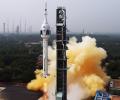
Chandrayaan-4 will involve at least two separate launches of the heavylift LVM-3 rocket that will carry five different components of the mission which will be assembled in orbit.
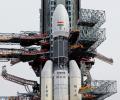
'It is time we Indians learnt to believe in ourselves, and stopped questioning our own capabilities every time a space launch is not a glorious success,' says M D Riti.

Aditya L1, the first space based Indian mission to study the Sun underwent the second earth-bound manoeuvre successfully, during the early hours on Tuesday, Indian Space Research Organisation (ISRO) said.
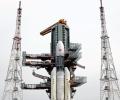
India's second moon mission Chandrayaan-2 is all set to be launched on board Indian Space Research Organisation's most powerful rocket GSLV-Mk0III-M1 from Satish Dhawan Space Centre in Shriharikota.

In terms of success rate, the PSLV rocket has an enviable record of 57 successful missions out of 58 commercial ones.

Astronaut Shubhanshu Shukla concludes his 18-day stay at the International Space Station, praising India's ambition, confidence, and pride as seen from space. He echoes Rakesh Sharma's iconic words and expresses gratitude to all involved in the Axiom-4 mission.

10 stocks from the Nifty 200 index that offer good growth potential and scope to deliver decent returns from current levels, based on brokerage estimates.
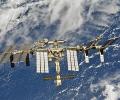
Once ISRO masters the technology to send humans into space, the next step will be experimenting with technologies allowing humans to live in space.
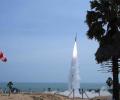
The fuel cost will come down if rockets are launched from Kulasekarapattinam as they will have a straight trajectory and need not have to avoid Sri Lanka, which is being done by rockets flown from Sriharikota.

Once Aditya L1 reaches its destination, it will help measure various events happening on the Sun for the next five years.

Just over 22 minutes into the flight, the rocket put Astrosat into orbit at an altitude of 650 km above the earth

AI reduces the time taken to find a target and launch a strike. This has led to a major increase in the pace of the conflict, with one report mentioning nearly 900 strikes launched on Iranian targets in the first 12 hours of an operation.

Chandrayaan-3 is now in an orbit, which when closest to Earth is at 173 km and farthest from Earth is at 41,762 km, the space agency said.

A three-member crew will be sent to space for at least seven days.
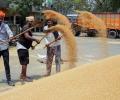
ISRO has projected wheat production of 122.24 million tonnes.

The National Aeronautics and Space Administration and Indian Space Research Organisation have shelved plans to train an Indian astronaut at NASA to be part of a manned mission of the American space shuttle.
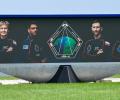
SpaceX, National Aeronautics Space Administration (NASA) and Axiom Space are closely watching weather patterns at the Kennedy Space Centre in Florida where Indian astronaut Shubhanshu Shukla and three others look forward to their travel to the International Space Station (ISS), now scheduled for Wednesday.
He underlined the importance of satellites in identifying ground water level, ideal fish catching zone, prediction of monsoon, disaster management, and bringing many Television programmes to the rural areas.
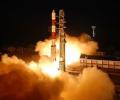
From relying on Russia for its first satellite launch, India is fast becoming a global hub to launch satellites, says T E Narasimhan
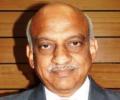
Alur Seelin Kiran Kumar was on Monday appointed as the new Indian Space Research Organisation chief. Kumar succeeds K Radhakrishnan, who retired on December 31, 2014, as the eighth chief of the prestigious space dispensation.

India will be the fourth country after the United States, Russia and China to send humans to space.
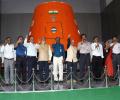
The space agency is gearing up for the human spaceflight programme by 2021-end that is likely to include a woman astronaut.
NASA plans to deploy mini-synthetic aperture radar and spectrometer with 0.3 micron to 0.9-micron capabilities in the Indian spacecraft for experiments.
India is planning to send one of its citizens into space, on board a Russian spacecraft, to acquire the skills necessary for future manned space missions. ''India would like to have one of its astronauts trained in Russia and send him into space on board the Soyuz spacecraft,'' an anonymous senior source in the Indian Space Research Organisation said. He said that the ISRO had been holding talks on the issue with the Russian Federal Space Agency, with a positive response.

Here is ISRO's SAC Director, Nilesh M Desai explains the crucial stage of soft landing.

Kareena Kapoor says that like any other Indian, she is also waiting 'with bated breath' for Chandrayaan 3 to land on the Moon's surface and she plans to watch the event with her children.
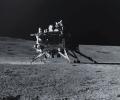
The cryogenic upper stage of the LVM3 M4 launch vehicle, which successfully injected the Chandrayaan-3 spacecraft into the intended orbit on July 14 this year, made an uncontrolled re-entry into the Earth's atmosphere, the ISRO said.
The American agency is in talks with ISRO to place its scientific instruments on the Indian spacecraft that will be sent on an unmanned mission to the moon in 2007.
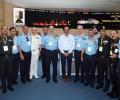
The space agency has redefined the mission in such a way that it will achieve success in the very first attempt.
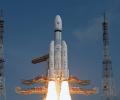
The test vehicle development flight (TV-D1) will be conducted at the Satish Dhawan Space Centre in Sriharikota in Andhra Pradesh to test the crew module that is scheduled to house Indian astronauts during the human spaceflight late next year.
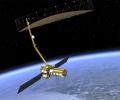
NISAR will not be used for surveillance and will be used to observe the earth.

At least 17 different tests are planned by ISRO next year before it carries out the unmanned space flight in December next year.

'It's vital that over the next 10 years, that India, the US and the Artemis Accords family of nations come together to ensure that we not only return humanity to the moon, but that we build the technology that will allow us stay there permanently.' 'And then go on to Mars.'

'We are planning to send an unmanned mission prior to the man mission, in next two years.'

In a major boost to the Indian scientific community, the Mars Orbiter Mission (Mangalyaan), on its maiden tryst with the red planet, has completed 300 days of its journey in space and is just 23 days away from reaching its intended orbit.

'Nitish Kumar may be marginalised as an office-holder, but that is not the same thing as the disappearance of Nitish Kumar's politics.'

People gathered in educational institutions, offices, city squares and religious places to watch the Indian Space Research Organisation's live telecast of Chandrayaan-3's final descent to the uncharted surface of the lunar south pole.

In a boost for the country's surveillance capabilities to monitor activities of both military warships and merchant shipping in the Indian Ocean Region (IOR), the 'Sindhu Netra' satellite developed by a team of young scientists from Defence Research and Development Organisation (DRDO) was successfully deployed in space on Sunday.
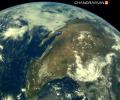
The pictures were captured by L 14 camera on board Chandrayaan II. The pictures show the earth in different hues.
